Featured Recipe

Lentil Rye Rolls adapted from Dan Lepard


The lentils are cooked until soft, but not mushy, before added to the dough so that they incorporate well and bake moistly. You can also use canned lentils here. With a perfect crust and tender crumb, these lentil rye rolls are wonderful with soup or salad for a satisfying and healthy meal. If you want to freeze the bread, cool them completely first, then transfer to a Ziploc bag, press out any excess air, and seal. Reheat them at 180C/350F for about 10 minutes.
|
|
 angiesrecipes
- Beat the cooked lentils with the water, yeast and honey, and leave aside. In a large bowl combine flours with the salt, then pour the lentil mixture in. Mix ttp://iuntil a soft and sticky dough forms. Cover with a plastic wrap and leave for 10 minutes.
- Rub 1 teaspoon of olive oil on the work surface and knead the dough on the oiled surface for 10 seconds, ending with the dough in a smooth, round ball. Clean and dry the bowl, then rub lightly with a teaspoon of olive oil. Return the dough to the bowl, cover, and leave for an additional 10 minutes. Remove the dough and knead once more on the oiled surface, returning the shape of the dough to a smooth round ball. Place it back in the bowl, cover, and leave for 1 hour in a warm place.
- Lightly flour a parchment paper and roll the dough into a sheet, about 10 x 8 inch. Cover the surface of the dough with a cloth and leave for 1 hour, or until almost doubled in height. Preheat the oven to 210C410F. Uncover the dough and cut into 16 squares. Bake in the center of the oven for 25 minutes, or until the tops of the rolls are golden brown and feel light.


Pita Bread


Pita bread is consumed in Turkey, where it is called “pide bread”, Greece and Romania. The word pita is a Greek term, which means “flat” and spelled “pitta bread” in English. In addition to being flat, pita bread generally has two layers which, after baking separate to form an internal pocket. This pocket occurs because of the extremely high temperatures at which the bread is baked.
- 250 ml Lukewarm water<
- 1 tsp Sugar
- 1 tsp Salt
- 420 g German #550 flour
angiesrecipes
- 4 g Instant dry yeast
angiesrecipes
- To make the dough in a bread maker, put all of the ingredients into the bread machine in the order listed, select the “dough cycle” and press “start” . The bread maker stops the process after the first rising.
- Upon completion of the dough cycle turn the dough onto a floured work surface. Knead the dough until all the air has been removed and divide it into 6 or 12 pieces. Round each into a small ball and then flatten them to make 1.5mm thick disks. Cover the dough with plastic wrap and allow them to rest for about 30 minutes.
- Now place a baking tray on the middle rack of the oven and preheat the oven to 220C/450F. Arrange pita dough on the baking tray and bake for 6 or 8 minutes until lightly brown. You will need to bake them in two bathes. Remove from oven and place on a tray covered with a clean dishtowel, with another clean towel on top. When thoroughly cooled, pitas can be stored in plastic bags.


Turkish Flatbread (Pide)


Pide is a round bread flavoured with sesame or fennel seeds. There are regional variations in the shape, baking technique, and the toppings.
|
- Whisk together the flour and dry yeast in the mixing bowl of a stand mixer attached with a dough hook. Add in salt, water, honey and olive oil. Mix first at slow speed, when the dough starts to come together, increase the speed to medium and knead until you have a soft, but smooth dough.
- Cover the dough with a plastic wrap and let sit in a warm place for about 45 minutes, or until doubled. Punch down and round into a ball. Divide in 8 smaller portions, cover with plastic wrap and let rest 10 to 15 minutes. The dough can be divided into 3 or 4 bigger ones as well, like we usually get from the supermarket.
- Flatten each dough into a 1cm thick round or any desired shape on a baking tray lined with parchment paper. Moisten the bread with water and sprinkle some sesame on the top. Again leave them, covered on the tray for about 30 minutes. Heat oven to 220C/450F and bake for 12-15 minutes.


Curry Stuffed Bread-Kare Pan
 © 2008 | http://angiesrecipes.blogspot.com
 © 2008 | http://angiesrecipes.blogspot.com
Curry Bread, or curry doughnut is a popular Japanese food. An amount of Japanese curry is wrapped in a dough, which then breaded with Panko fresh bread crumbs, and deep fried until golden crispy.
| Curry Filling | Dough | Others |
|---|---|---|
|
|
|

- Heat the olive oil in a skillet over medium heat. Add the sliced onions and sautee over medium-high heat, stirring often, until lightly browned. Stir in ground beef and cook for about 5 minutes. Stir in the grated carrot and sautee for 1 minute. Pour in the white wine and bring to a boil over high heat. Add in curry and chilli sauce. Continue to cook, stirring occasionally, until the liquid is reduced by half. Stir in the dissolved cornstarch and cook until thickened. Season with salt to taste. Set aside to cool completely. Cover and refrigerate until ready to use.
- To make the dough in a bread maker, put all of the ingredients into the mixing bowl of your bread machine in the order listed, and set the machine to create dough. When the machine finishes, roll out the dough on a lightly floured work surface. Divide the dough into 8-10 even portions. Round up, cover with plastic wrap, and allow to rest for 15 minutes. Combine egg and milk.
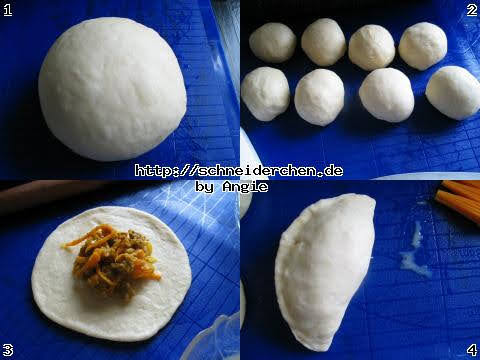
- Roll out the dough on a lightly floured work surface into a 4-inch round. Place some of the filling in the center of the round. Fold each of them in half to enclose the filling in a semi-circle. Be sure that the seam is well sealed. Dip the bun into the egg wash, coating it on all sides, then roll in bread crumbs. Place them on a tray lined with parchment paper and let rise for about 20 minutes. Heat up a skillet with oil until 180C/350F. Place the bread into the oil and fry until golden brown on both sides, about 60-90 seconds per side. Drain the curry bread on a kitchen towel.

 © 2008 | http://angiesrecipes.blogspot.com

Matcha Apricot Bread Wrapped In Chinese Pastry Dough


| Chinese Pastry | Dough |
|---|---|
|
|

- Sift the flour in a mixing bowl, add in baking powder and salt and stir together. Add in butter and water and mix until soft and smooth. Cover with a plastic wrap and allow to rest for 30 minutes.
- In a mixing bowl, stir ingredients A and B for the dough at slow speed for 1 minute. Increase the speed and continue to mix until a rough dough forms, about 3 minutes. Stir in butter until the dough has become smooth and elastic. Add in almond and apricot. Mix at slow speed until well-combined.
- Place the dough in a lightly oiled container and cover closely with plastic wrap. Allow the dough to proof till doubled in size. Remove and divide the dough into 3 equal portions and allow them to rest for 10 minutes. Cut the pastry dough into 3 equal portions too.
- Flatten each pastry dough lightly with your hand. Round each dough and place them in the center of each pastry dough. Seal the dough by pinching all sides together to make a neat package of each. Arrange the rolls, pinched side down, on a baking sheet. Cover and let rise for 1 hour. Slash the loaves diagonally 2 or 3 times with a razor blade, deep enough to see the matcha dough. Sprinkle the top with some seeds if desired. Bake in the preheated 175C/350F oven for 30 minutes.


Brioche


Rich, buttery, sweet or savory brioche is a French bread and often served for the breakfast. A classic brioche has a fluted bottom and an upper protruding knob, and is made in a special flute-shaped brioche pan. The bread can also be baked like a regular loaf, or braided (same as we do the Challah) or made in muffin cups. Sweet brioche is filled with chocolate or candied fruit while cheese, vegetables or meat are very often found in the savory version.
|
|
- In a large mixing bowl whisk together flour, sugar, salt and yeast. Make a well in the center of the mixture and add in the eggs. Mix in, then work together with a fork to make a soft dough.
Turn out onto a lightly floured surface and knead until you have a shiny and smooth dough, about 10 minutes. Pound the butter with the side of a rolling pin until it's pliable. Add the butter to the dough and knead until it's fully incorporated. Cover with a plastic wrap, then a towel. Place the bowl in an oven (DO NOT HAVE THE OVEN TURNED ON ) with the oven light turned on and allow to rise for 1 hour.
- Lightly grease 10 muffin cups. Turn the dough out onto a lightly floured surface and press down the risen dough to release air. Divide the dough into 10 equal portions. Fill each with some chocolates and wrap up. Place them in prepared muffin cups.
- Cover them with a few layers of plastic wraps and refrigerate the dough overnight. The volume should be doubled and it crowned well over the top of the pan. Preheat the oven to 210C/410F. Brush the brioches tops with the milk and bake for 15 minutes in the middle of the preheated oven until golden brown.


Braided Raisin Bread With Lemon

 |
 |
|
|
- Soak the raisins in a bowl filled with warm water for 20 minutes until soft. Drain.
- In a mixing bowl put flour, sugar, pinch of salt, butter, egg and lukewarm milk. Crumble the fresh yeast on top of the ingredients. Using a stand mixer blend all the ingredients at slow speed until a dough forms. Then adjust to middle speed and knead for about 5 minutes until dough comes off easily from bowl and smooth. Add the thoroughly drained raisins and lemon zest. Knead for another 30 seconds until well-combined.
- Cover the dough and let rise for 45 minutes. Punch down and divide the dough in 3 equal pieces and roll into ropes. Loosely braid the ropes and put on a greased baking tray. Let rise for another 30 minutes until braid is plump and doubled in size. Brush with milk and bake for about 30 minutes at 190C/375F.


Croissants / 羊角面包


Croissant...This delicious pastry originated in Budapest in 1686, when the Turks were besieging the city. To reach the centre of the town, they dug underground passages. Bakers, working during the night, heard the noise made by the Turks and gave the alarm. The assailants were repulsed and the bakers who had saved the city were granted the privilege of making a special pastry which had to take the form of a crescent in memory of the emblem on the Ottoman flag.
Alan Davidson, the author of Oxford Companion to Food, expresses his doubts. Culinary mythology--origin of the croissant According to one of a group of similar legends, which vary only in detail, a baker of the 17th century, working through the night at a time when his city (either Vienna in 1683 or Budapest in 1686) was under siege by the Turks, heard faint underground rumbling sounds which, on investigation, proved to be caused by a Turkish attempt to invade the city by tunnelling under the walls. The tunnel was blown up. The baker asked no reward other than the exclusive right to bake crescent-shaped pastries commemorating the incident, the crescent being the symbol of Islam. He was duly rewarded in this way, and the croissant was born.
The story seems to owe its origin, or at least its wide diffusion, to Alfred Gottschalk, who wrote about the croissant for the first edition of the Larousse Gastronomique [1938] and there gave the legend in the Turkish attack on Budapest in 1686 version; but on the history of food, opted for the 'siege of Vienna in 1683' version."
|
|
- In a mixer with a dough hook, place the yeast, flour, sugar, salt and the milk and mix for 2 minutes until a soft moist dough forms on the hook. If the dough is not moist, add more milk, half tablespoon at a time until it is moist and smooth, using not more than 2 tablespoons. Increase speed and mix until the dough is very smooth and elastic, about 2-3 minutes. Cover the dough and rest for 30 minutes in fridge.
酵母,面粉,砂糖,食盐和牛奶放入搅拌盆,揉成较湿润且柔软面团。如果面团稍干的话,可适量添加一些牛奶,每次加入半勺将面团揉成稍微湿润即可,用量不要超过2大勺为宜。提速继续搅打面团至光滑有弹性,2-3分钟。面团盖上保鲜膜冷藏松弛30分钟。
- Roll the dough on a lightly floured board to a 9 by 16 inch rectangle. Soften the butter by beating with a rolling pin. Place the butter over two-thirds of the length of the rectangle. Starting from the the unbuttered third, fold the dough, like a business letter, into thirds. Turn the dough a quarter degree, so that the open sides are at 12 and 6 o'clock. Roll again the laminated dough to a rectangle and fold into thirds. Wrap the dough with plastic film tightly and chill over night to ease the gluten.
工作台洒些面粉,放上面团擀成9x16寸的长方形。用擀面杖将牛油捶打至软身,将其铺放在三分之二的面团上。从未铺牛油的三分之一面团入手,折信般将面团三折。将面团转90度,让开口两端朝6点和12点。擀成长方形后再三折。面团包入塑料保鲜膜隔夜冷藏,松弛面筋。
- Remove from the fridge and perform the 3-fold three more times. Or two more times of 3-fold and a 4-fold turn for the final, which is to fold both ends into the center and then fold to close, like a book. Chill for 30 minutes to relax the dough between each turn. After the completion of the final turn, relax the dough in the fridge for 2 hours or overnight to fit your schedule. At this point the dough can be frozen until needed. Thaw the dough overnight in the fridge before shaping.
取出面团后重复3次3折或是2次三折后,然后四折收尾。所谓四折就是将擀开的面团头尾两端折向中心,然后再对折。每次折好后要冷藏松弛面团30分钟。完成最后一折后,面团需要至少2小时或是隔夜冷藏。这时面团可以冷冻保存,使用前必须提前放到保鲜柜退冻后才能使用。
- On a lightly floured surface, roll out the dough to a rectangle with about 4mm in thickness. Trim irregularities and divide the dough with a pizza cutter or knife (using croissant cutter if available) into triangles, about 4-inch wide, or wider if you prefer croissants more curved. Gently stretch the base of the triangle to widen it slightly, while one hand holds the base, pull the dough with the other to lengthen the dough, so that a quality croissant with multi layers. Roll up starting at the wide bottom to make a curved cresent shape and place them on a baking paper lined pan.
将面团放到铺了少许面粉的台面上,擀成4毫米左右厚度的长方形。 用皮萨饼轮刀或刀子(要是有专用羊角包割面刀就更佳了)将其切成4寸宽三角块。如果喜欢面包两角更有弯度的话,可以宽一些。轻轻将三角面团的底部拉宽一些,一手按住底部,另一手轻轻将面团拉长,这样面包的层次会更加清晰。从宽底部将其卷起成新月状放入铺放了烤纸的烤盘上。
- To proof the croissants, place them in an oven that is warm but not turned on, with a pan of hot water in the bottom to create a moist environment, which is beneficial to the proofing. Let rise until croissants puffed up and spongy to the touch, 2-3 hours. Remove from the oven. Preheat the oven to 200F/400F. Mix egg and milk together in a bowl. Brush with the egg wash and bake the croissants for 22 to 25 minutes until golden brown. Allow them to cool on a rack before serving.
烤箱不要通电,并且在底部放入一大盘热水营造湿润温暖的环境,有利于醒面。将整形好的面包胚放入烤箱进行发酵。2-3小时后,面包明显膨胀,手触面团有弹性。取出面包后,预热烤箱至200C/400F。牛角包表面刷上鸡蛋和牛奶混合液,入预热后的烤箱烘焙至金黄色,22-25分钟。取出后放到架上晾凉。


 Posts
Posts